Public Health Career · BLS May 2025
Community Health Worker Salary and Jobs
How Much Do Community Health Workers Make, and Do You Need a Degree?
The median community health worker salary was $51,850 in May 2025, across 61,660 jobs (BLS). You don't need a degree to start: BLS lists a high school diploma plus on-the-job training as the typical entry, and some states require certification. An MPH is a step up, not a starting requirement; it leads to health educator, program and management roles. Compare community health MPH programs.
Community Health Worker Pay: $38,810 to $77,180
The median is the midpoint: half of community health workers earned more and half less. The 90th percentile shows where experienced and senior roles land; the 10th, where many new graduates start.
What a Community Health Worker Does
Community health workers are the link between people and the health and social services they need. The job is hands-on and local. The Bureau of Labor Statistics (BLS) lists these core duties:
- Coordinate care among individuals, communities and health and social service systems
- Conduct outreach, including home visits
- Provide culturally appropriate health information and resources
- Handle case management and help people access resources
- Advocate for housing, food security and other needs
- Coach and support people, such as nutrition training, recovery support for mental health and substance use, and chronic disease management
- Provide basic health screenings and first aid
- Bring more people into community health assessments and education
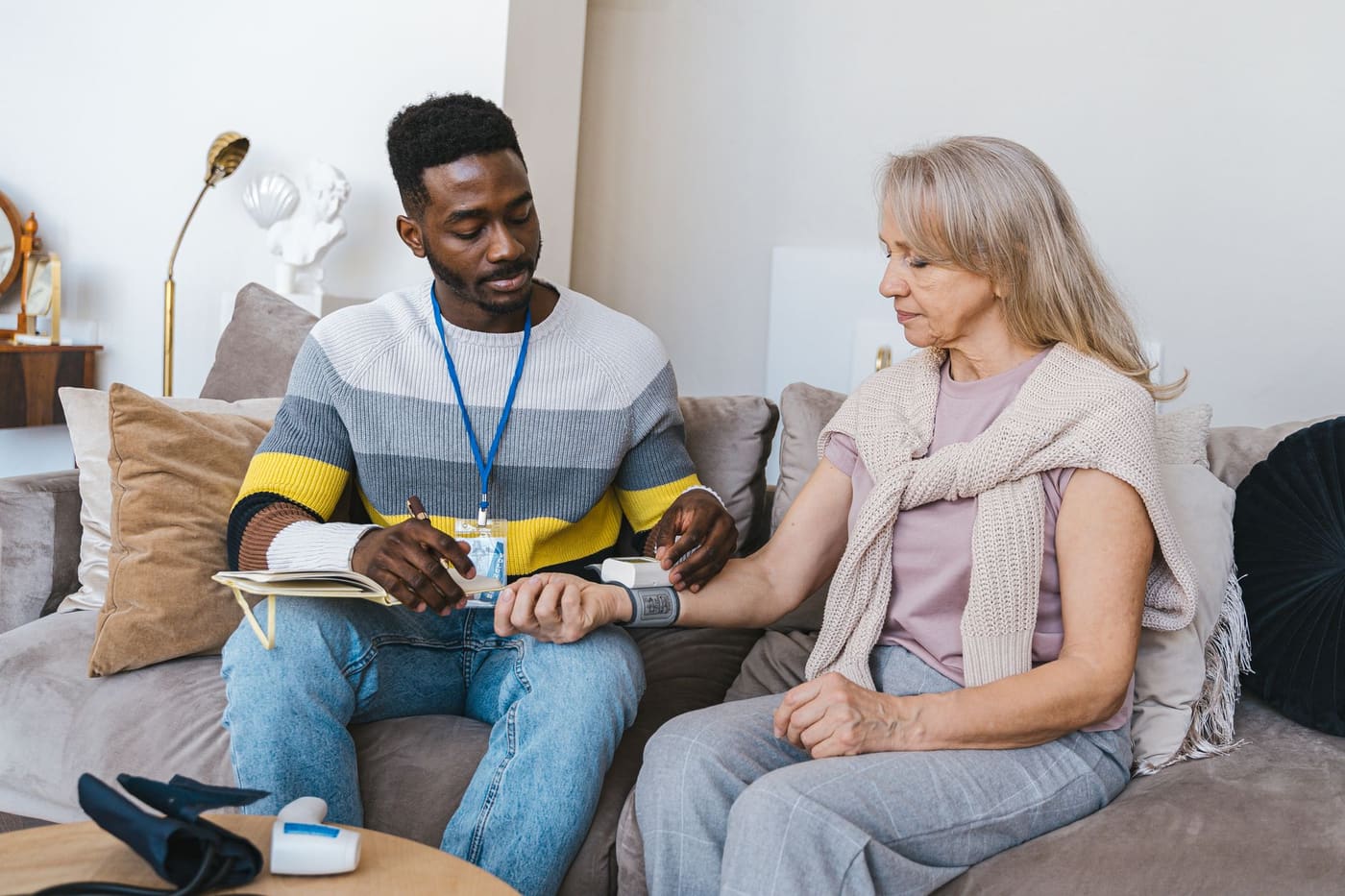
A typical day might include a home visit to check a client’s blood pressure, a phone call to help another client book a clinic appointment, and an evening community event. BLS notes that most community health workers work full time, often with evening and weekend hours, and travel to homes and medical facilities to meet clients.
Where Community Health Workers Work
| Employer | Share of jobs |
|---|---|
| Ambulatory healthcare services | 22% |
| Social assistance | 20% |
| Local government | 18% |
| Hospitals | 12% |
| Religious, civic and professional organizations | 8% |
Source: BLS Occupational Outlook Handbook. Local government excludes education and hospitals.
Unlike most public health careers, community health work is spread across clinics, social service agencies, local health departments, hospitals and community organizations, with no single dominant employer. That’s good news if you want options close to home.
Community Health Worker Salary by State
Community health work is one of the few jobs where the two biggest markets also pay near the top. California (9,500 jobs) and New York (5,800 jobs) have medians of $58,050 and $58,130, both well above the national $51,850. The highest medians are in smaller markets: New Hampshire ($66,680, 200 jobs), the District of Columbia ($62,510, 280 jobs), North Dakota ($59,610, 90 jobs) and Hawaii ($58,450, 240 jobs).
| State | Jobs | Median pay |
|---|---|---|
| California | 9,500 | $58,050 |
| New York | 5,800 | $58,130 |
| Texas | 4,210 | $48,720 |
| Maryland | 3,030 | $50,550 |
| Massachusetts | 2,970 | $55,560 |
| Washington | 2,640 | $57,070 |
| Illinois | 2,040 | $49,240 |
| Oregon | 1,980 | $53,350 |
Source: BLS OEWS, May 2025.
Texas, Maryland and Illinois have large job counts but medians below the national figure. The lowest medians are in Puerto Rico ($36,900, 670 jobs), West Virginia ($37,950, 310 jobs), Mississippi ($39,520, 410 jobs) and Tennessee ($42,310, 520 jobs).
The pay band inside the occupation is narrow compared with other public health careers. A quarter of community health workers earned less than $45,640 and a quarter earned more than $62,540. The top tenth earned more than $77,180. The bigger pay jumps on this page come from the roles above it, covered below.
How to Become a Community Health Worker
BLS is clear that this is not a degree-first career. Community health workers typically need at least a high school diploma, although some jobs require postsecondary education, and most learn the job through on-the-job training. The steps look like this:
- Start with what you have. A high school diploma is the typical entry requirement.
- Check your state’s rules. Some states require certification, which may include an approved training program. Your state health department sets the requirements.
- Build language and people skills. BLS lists communication, cultural sensitivity, instructional, interpersonal and problem-solving skills as the qualities that matter, and notes that a second language helps in some communities.
- Add education when you want to move up. A bachelor’s degree opens health educator jobs, and a master’s opens program and management roles.
Where an MPH Fits
An MPH is not the direct route into community health work, and paying for one just to become a community health worker doesn’t make sense on BLS pay figures. Where it helps is the next step. Here is how the career ladder compares, using BLS figures for May 2025:
| Role | Typical entry education (BLS) | Median pay |
|---|---|---|
| Community health worker | High school diploma | $51,850 |
| Health education specialist | Bachelor’s degree | $64,070 |
| Medical and health services manager | Bachelor’s degree; master’s for top roles | $123,860 |
A community health MPH is built for the middle and upper rungs: designing the programs community health workers deliver, supervising outreach teams, evaluating results and managing budgets. Every CEPH-accredited MPH also includes an applied practice experience, which gives you supervised program-level work to put beside your field experience.
Choosing Your Next Credential
If you’re a community health worker thinking about more school, the order matters. A master’s degree comes after a bachelor’s, so the realistic sequence is a bachelor’s, then a job as a health educator or program coordinator, then a master’s when you’re ready to lead programs.
Three credentials are worth knowing:
- A bachelor’s in health education or health promotion. BLS names this as the typical entry degree for health education specialists, the next rung up.
- CHES certification. The Certified Health Education Specialist credential from NCHEC requires a bachelor’s, master’s or doctoral degree with either a health education major or at least 25 semester credits of health education coursework. BLS notes that employers may require or prefer certification for health education specialists. The CHES certification guide covers the exam.
- A master’s degree. Shorter options such as a 30-credit Master of Health Education can take about a year; a CEPH-accredited MPH usually runs about 42 credits and adds broader public health training and the CPH credential option.
Where the Programs and the Jobs Overlap
Studying where you already work keeps your job and your network intact. The states with the most community health programs on this site line up with the biggest community health worker job markets:
| State | Community health programs on this site | CHW jobs | CHW median pay |
|---|---|---|---|
| California | 28 | 9,500 | $58,050 |
| New York | 18 | 5,800 | $58,130 |
| Texas | 14 | 4,210 | $48,720 |
| Illinois | 12 | 2,040 | $49,240 |
| Pennsylvania | 11 | 1,970 | $50,710 |
Program counts from this site’s program records; jobs and pay from BLS OEWS, May 2025.
California and New York offer the most program choice and the best-paying large job markets for community health workers. In Texas and Illinois, pay for the entry role is lower, which makes the move up to a health educator or program role more valuable. Maryland is a similar case: 3,030 community health worker jobs at a $50,550 median, with 6 community health programs on this site, and a health educator median in the state far above the national figure.
Community Health Master’s Programs for Working Adults
This site lists 228 community health, health promotion and health education programs, 109 of them offered online and 31 hybrid. For someone already working in the field, these stand out for format:
- Western Colorado University Master of Behavioral Science, Rural Community Health: hybrid, 39 credits over two years, $730 a credit plus fees, GRE optional. A rare program focused on rural community health.
- Cal State Northridge Online MPH in Community Health Education: 42 units, asynchronous, about 2.5 years, $857 a unit, with the cohort limited to 37 students. GRE not required.
- Touro University California Online MPH: 42 credits over five semesters with a Community Action for Health concentration, $1,070 a credit.
- Idaho State University Master of Health Education: 30 credits online or on campus, in as little as 12 months, at $613 a credit for residents.
- National University MPH: 48 credits in 4-week courses with a Community Mental Health concentration, $644 a credit.
Across the 87 programs that publish both a per-credit rate and a credit total, estimated tuition (published per-credit rate times credits, before fees) runs from $12,915 to $118,608, with a median of $32,079. Against a community health worker’s median pay, the low end of that range is the realistic target. Browse affordable MPH programs and online MPH programs for more.
Community Health Worker Job Outlook
BLS projects employment of community health workers to grow 13 percent from 2025 to 2035, much faster than the average for all occupations, with about 7,000 openings a year. For people starting without a degree, that’s a steady stream of entry-level openings.
Before you apply to any master’s program, read what an MPH degree is and whether an MPH is worth it for your goals.
Highest-Paying States for Community Health Workers
| State | Median | 90th percentile | Jobs |
|---|---|---|---|
| New Hampshire | $66,680 | $77,010 | 200 |
| District of Columbia | $62,510 | $93,070 | 280 |
| North Dakota | $59,610 | $76,210 | 90 |
| Colorado | $59,260 | $76,790 | – |
| Hawaii | $58,450 | $84,750 | 240 |
| New York | $58,130 | $87,980 | 5,800 |
| California | $58,050 | $88,590 | 9,500 |
| Nevada | $57,730 | $95,200 | 670 |
| Washington | $57,070 | $80,680 | 2,640 |
| Delaware | $55,850 | $74,530 | 280 |
BLS publishes 21-1094 estimates for 52 states. Full list on the MPH salary page.
The MPH Path: Community Health and Health Promotion
228 programs we verified offer community health and health promotion, as an MPH concentration or a related master's degree. These online MPH programs at CEPH-accredited schools are a place to start:
- MPH
Master of Public Health
University of Alabama at Birmingham · Birmingham, ALOnlineOn campusNo GRESOPHAS6 concentrations- Credits
- 42
- Tuition
- $526/cr
- Length
- 5 sem
CEPH - MPH
Master of Public Health in Health Education and Promotion
The University of Alabama · Tuscaloosa, ALOn campusOnline- Credits
- 42
- Tuition
- $480/cr
CEPH - MPH
- Credits
- 42
- Tuition
- $950/cr
- Length
- 2 yr
CEPH - MPH
Master of Public Health - Health Promotion (Online)
Northern Arizona University · Flagstaff, AZOnline- Length
- 2 yr
CEPH - MPH
Online Master of Public Health (SDSU Global Campus)
San Diego State University · San Diego, CAOnlineSOPHAS2 concentrations- Credits
- 51
- Tuition
- $629/cr
- Length
- 22 mo
CEPH
All community health and health promotion programs
Frequently Asked Questions
How Much Do Community Health Workers Make an Hour?
The median hourly wage for community health workers was $24.93 in May 2025. The mean annual wage was $56,180.
Is Community Health Work a Growing Field?
Yes. BLS projects employment of community health workers to grow 13 percent from 2025 to 2035, much faster than the average for all occupations, with about 7,000 openings a year on average.
Do Community Health Workers Need a Certification?
It depends on the state. BLS says some states require certification for community health workers, which may include completing an approved training program. Check your state health department's requirements before you apply for jobs.
Does Speaking Another Language Help?
Yes. BLS notes that the ability to speak another language is helpful for working in some communities, and cultural sensitivity is one of the important qualities it lists for the job.
Can a Community Health Worker Become a Health Educator?
Yes, with more education. Health education specialists typically need at least a bachelor's degree in health education or health promotion, and they earned a median $64,070 in May 2025, compared with $51,850 for community health workers.
Sources
- BLS Occupational Employment and Wage Statistics, 21-1094 Community Health Workers, May 2025
- Official program pages of the schools listed, reviewed September 2026
- BLS Occupational Outlook Handbook: Community Health Workers
- BLS Occupational Outlook Handbook: Health Education Specialists
- BLS Occupational Outlook Handbook: Medical and Health Services Managers